At what age should your child go out alone in the evening? The first releases guide
Reading: 7 min
Summarize this article
Save time by using AI to summarize this content.
The main thing to remember
- No single age: maturity and preparation count more than the calendar.
- A progression in stages establishes the confidence.
- A quick checklist before each outing reassures everyone.
- To stay in touch, a smartphone like NEOW Safe, with Eos Neow, or a connected watch allows your child to contact you easily.
- Light clothing and a reflective element make it much more visible.
He There is no single age for letting your child go out alone in the evening: maturity and preparation count more than the calendar, and autonomy is built in stages. Maturity benchmarks, checklist before each outing, ways to keep in touch, rules discussed together and reflexes for being seen at night: enough to prepare for these first outings at your own pace.
Summary
- At what age should you let your child go out alone in the evening?
- Before each outing: the checklist
- Keep in touch without monitoring
- Be seen when it's dark
- Time of return, journey, evening at a friend's house: the rules to decide together
- The case of Halloween
- Frequently asked questions
- Sources and references
For many children, theHalloween candy hunt is the first outing after dark without an adult. After the change to winter time, the return from sport or school also takes place in the dark. So, at what age should your child go out alone in the evening? An outing needs to be prepared for two people: here are some guidelines for progressing at your own pace.
At what age should your child go out alone in the evening?
There is no single age valid for all children: it is their maturity and preparation that count, with autonomy that is gradually built. As for knowing how old to get a first phone, it is often your child himself who gives valuable clues.
A few markers show that he feels ready:
- he knows his route and his address;
- he respects the traffic rules without being reminded of them ;
- he knows how to ask an adult for help;
- he calls when agreed and keeps the return time.
Many families move forward in stages: daytime before evening, accompanied, then in a group, then alone; a short and known route before a new route. Every successful outing builds confidence, both yours and yours.
Before each outing: the checklist
A shared checklist allows everyone to know what is planned and establishes a simple safety framework. The points that many parents review:
- the route, chosen together;
- the return time, clear for everyone;
- who he goes out with and who he goes to;
- an outfit that makes him visible in the night;
- a well-charged phone or watch;
- a point of appointment, and the number of his parents known by heart or written down;
- the “we call if…” rule: delay, change of plans, discomfort;
- an emergency solution: a trusted adult to contact, an open and lit place to wait.
This overview takes two minutes and often alleviates concerns on both sides.
Keep in touch without surveillance
For many parents, the main thing is simple: knowing that their child has arrived safely, and that he can contact them if his plan changes. A message on arrival, a call when leaving: these little rituals are often enough.
This is often where the question of the telephone arises. A clue: a first secure smartphone like a Neow Safe or Safe+. Your child can call you, write to you or notify you of a delay, and you set the parental control settings and digital environment appropriate for their age. The benefit is twofold: you know that he can contact you, and he experiences his exit independently.
For the youngest, or when you prefer not to entrust a smartphone, a children's smartwatch is another option. On certain models in the collection, only contacts validated by parents can call the child or send them a message.
Position sharing is the choice of each family: some parents use it occasionally, in agreement with their child; others do without it.
Glossary
Connected watch for children : an option to keep in touch without handing over a smartphone; on certain models in the collection, only contacts validated by the parents can call the child or send him a message.
Position sharing : a possibility which is the choice of each family, used punctually and in agreement with the child, or not at all.
Emergency solution : a trusted adult to contact, or an open and lit place to wait, provided before going out.
Being seen at night
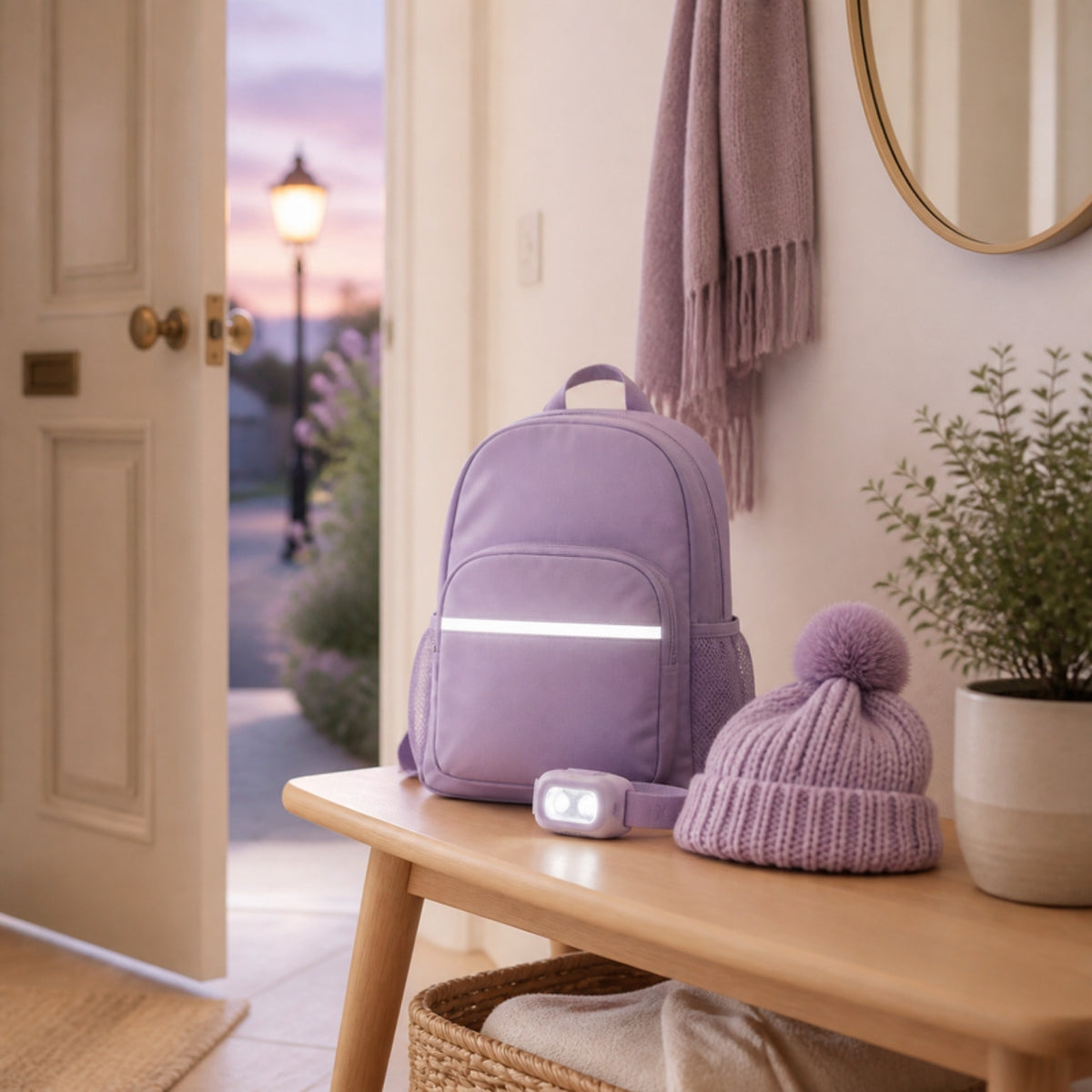
To be seen at night, light clothing and reflective elements make all the difference. A small accessory is sometimes enough: according to theAssociation Prévention Routière, 2023, a retroreflective sticker on a child's schoolbag makes it visible at 150 meters, compared to 30 meters in conditions normal.
Key figures
- 150 meters : the distance at which a retroreflective sticker on the schoolbag makes a child visible, compared to 30 meters in normal conditions (Association Prévention Routière, 2023).
Return time, journey, evening at a friend's house: the rules to set together
The rules often work better when they are discussed rather than imposed: a child who participates in their definition takes ownership of them more.
The return time can take into account his age and the length of the journey, with the habit of warning as soon as a plan changes. For an evening at a friend's house, an exchange with the parents who are hosting allows you to establish the address, the times and who is escorting who.
What if a rule is not respected? Some parents choose to talk about it again calmly, then return to the previous step in the progression, taking the time to find their bearings.
Halloween
For Halloween, a few simple ideas make the evening a good memory:
- a colorful costume, short enough to run without tripping ;
- make-up rather than a mask, to keep your eyesight clear;
- a flashlight or glow stick to complete the costume;
- a group outing, with an adult for the youngest;
- a route known to parents, ringing at lit houses;
- you don't go into a stranger's house and go up not by car;
- the inventory of candies and other treats on the way back, with an adult.
| Theme | References |
|---|---|
| Age and maturity | No single age. Markers: he knows his route and his address, respects traffic rules, knows how to ask for help, calls when agreed. |
| Progression | Daytime before evening, accompanied, then in a group, then alone; a short, known route before a new route. |
| Before each outing | Itinerary chosen together, clear return time, with whom and to whom, visible clothing, charged phone or watch, meeting point, “we call if…” rule, emergency solution. |
| Keeping in touch | A message on arrival, a call when leaving; secure smartphone with Éos Neow or connected watch; location sharing according to the choice of each family. |
| Visibility at night | Light clothing, reflective element; pedestrian crossings, sidewalk, an eye on cars backing up or turning. |
| Rules to be set | Discussed rather than imposed; return time depending on age and route; notify as soon as a plan changes; exchange with the parents who receive them. |
| Halloween | Colorful costume, makeup rather than a mask, flashlight or light stick, group outing, lit houses, inventory of treats upon return with an adult. |
Frequently asked questions
Sources and references
- Association Prévention Routière (2024) : “making yourself visible is first of all choosing light-colored clothing.”
- Association Prévention Routière (2023) : a retroreflective sticker on a child's schoolbag makes him visible at 150 meters, compared to 30 meters in normal conditions.